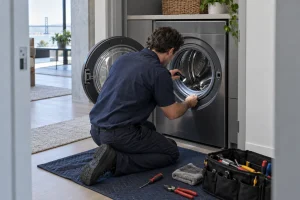
Washer Repair in San Francisco
Front-load, top-load, SideKick and WashTower: we trace drain, door, noise and leak problems on LG washers across San Francisco and the Bay…

Specialized LG Appliance Repair in San Francisco
Mon–Sat: 8:00 AM – 7:00 PM
Learn how to read your washer's label and code, and what to try before booking an LG washer repair.
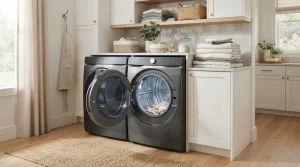
Laundry space in the Bay Area is rarely generous. LG washers here sit in hallway closets, garage corners, basement laundry rooms, shared building rooms and under-counter alcoves, and the location often decides what goes wrong and how a technician reaches the machine. This guide walks through the washer types we repair, how to read the model label, and what you can safely check before a visit.
Front-load units include the compact-drum WM1385H and WM1388H, plus the larger-drum WM3085C, WM3090C, WM3095C and WM3180C. Top-load units include the WT1150C, WT1501C, WT1901C, WT5275C, WT7050C and WT7060C.
Beyond these we service SideKick pedestal washers that sit beneath a main LG washer, washer-dryer combos, and WashTower stacks where the washer and dryer share one cabinet. Each of those has its own installation quirks, which is why the label matters.
On front-loaders the label is usually inside the door opening or on the rear panel. On top-loaders look under the lid, along the cabinet rim or at the back. Photograph it and keep the shot ready; the exact number tells us the drive type, control board and drain arrangement before we arrive.
Codes tend to fall into three groups: water in, water out and the door. IE means the tub is not filling to the required level in the expected time, so check taps and inlet screens. OE is a drain failure, often a kinked hose or a clogged pump filter. UE means an unbalanced load or a washer that is not level. Door-related faults include dE2, the door closed but not locked, and dL, a latch problem that may involve a foreign object in the lock. Pedestal owners should know E7, which points at the stacking switch or a SideKick that is not installed correctly. Browse the rest on the error codes page.
San Francisco buildings add a few twists. Many laundry closets have a standpipe drain that sits too high or too tight for the hose, which produces slow drains and false drain faults. Older floors flex, so a washer that was level last year may now rock during spin. Stacked washer-dryer towers and WashTower units need their wiring and drains laid out carefully, and a sticky sensor on a stack can look like a washer fault. Garage installs can see cold nights that stress water lines.
Please leave the cabinet closed. Do not bypass the door switch, and shut the water off if you find a leak.
When the owner checks do not clear the problem, LG washer repair is the next step: we diagnose first, give you a written estimate, and repair only after you approve it.
Front-load and top-load washers, SideKick pedestal washers, washer-dryer combos and WashTower stacks.
Usually inside the door opening on front-loaders, and under the lid or along the cabinet rim on top-loaders. A clear photo of the label is ideal.
OE is a drain failure. Common causes are a kinked or high drain hose and a clogged pump filter. If the filter is clean and the hose is clear, a technician should look at the pump.
Yes. Poor clearance behind the machine can kink hoses, and an overly high standpipe slows drainage, both of which can trigger fill or drain faults.
Often it is residue in the gasket and drawer, which regular cleaning can handle. If the smell returns quickly or comes with a leak, book a diagnosis.
Front-load, top-load, SideKick and WashTower: we trace drain, door, noise and leak problems on LG washers across San Francisco and the Bay…
The LG WM1385H is a 2.3 cu ft front-load washer. We diagnose door lock, odor and drain problems on it in San…
The LG WM1388H is a 2.3 cu ft front-load washer. We handle drain, vibration and water-supply faults on it for San Francisco…
The WM3085C is a 4.5 cu ft front load washer. Here is what usually goes wrong with this kind of washer, what…
A 4.5 cu ft front load washer in our LG catalog, the WM3090C. See common complaints, safe owner checks and what to…
The WM3095C is listed as a 4.5 cu ft front load washer. Learn the usual no-spin, leak and no-start causes and what…
The WM3180C is a front load washer of 4.5 cu ft in our LG catalog. Read about fill, drain and sensor problems…
The WT1150C is a top load washer of 4.5 cu ft in our LG catalog. See common lid, drain and spin faults…
The WT1501C is listed as a top load washer of 4.5 cu ft. Learn what causes no fill, slow spin or noise…
The WT1901C is a top load washer with a 5.0 cu ft tub in our LG catalog. See what bigger tubs mean…
The WT5275C is a 4.5 cu ft top load washer in our LG catalog. Read about vibration, sensor and drain faults and…
The WT7050C is a 4.5 cu ft top load washer in our LG catalog. Find out about sensor, heating and drain faults…
The WT7060C is a 4.5 cu ft top load washer in our LG catalog. Read about app connection, lid and spin problems…
Gas, electric and induction cooktops set into the counter: how the LG lineup is laid out, where the label hides and what…
LG dishwashers we repair in San Francisco kitchens, with model labels, display codes, drain and fill issues and safe owner checks.
Electric, gas and ventless heat pump LG dryers we repair in San Francisco, with model labels, airflow tips, codes and safe owner…
Over-the-range microwaves with convection or exhaust fans: how the lineup works, where the label is and what to check when heating, the…
Freestanding and slide-in ranges, single, double and combination wall ovens: what the LG lineup looks like and what we check when one…
French-door, side-by-side, top-freezer and kimchi LG refrigerators we repair around San Francisco, with models, codes and first checks.
LG Styler steam closets refresh clothes with steam and moving hangers: how they are built, where the label sits, what the codes…
Share a few details and we’ll confirm an appointment. Prefer to talk? Call us and we’ll help right away.