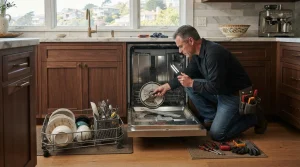
Dishwasher Repair in San Francisco
Water that will not drain, a door that will not latch or dishes that stay dirty? We diagnose LG dishwashers across San…

Specialized LG Appliance Repair in San Francisco
Mon–Sat: 8:00 AM – 7:00 PM
Understand the fill, drain and latch problems that stop LG dishwashers, and what to check before you book.
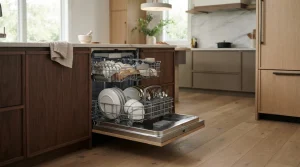
Kitchens in San Francisco are compact, and a dishwasher usually has to share a cabinet run with a sink, a garbage disposal and a tight set of supply and drain connections. That arrangement explains many LG dishwasher complaints. Below we cover the lineup, how to find the model label, typical faults, and what you can check without opening the machine.
The catalog covers the LG SIGNATURE SDNAH981 and SDNVH981, and the LDNFC33L, LDNPQ44H, LDNTC326, LDPH676, LDWBC22BT and LDWPC12BL. LG markets features such as QuadWash and TrueSteam across its range, and we treat those as general feature names rather than something to assume about a specific unit.
The model and serial label on most dishwashers is on the inner edge of the door or along the tub rim, and sometimes on the side of the door panel. Open the door fully and look around the frame. Please photograph it before you call.
LG dishwashers give short letter codes. OE means the tub did not fully drain, which sends us to the drain hose, the air gap or disposal connection, and the pump. AE covers leakage or overfilling, from unlevel installation to a detected leak. bE is the bubble error, caused by oversudsing from dish soap or too much detergent. HE reports that the water is not being heated. PF is a power failure indicator: power was interrupted and the cycle stopped, and it is not a fault. Other codes sit on the error codes page.
Dishwashers often share a drain with the sink or disposal, and a high loop or air gap that is not set correctly leads to slow draining and odors. Hard water in some neighborhoods leaves film on spray arms and filters. In older flats, cabinets and countertops may leave little room to slide the unit out, so we plan access before the visit. If the dishwasher is not level, doors can fail to latch and leak at the seal.
Do not remove the lower kick panel or work on wiring. If water is leaking onto the floor, close the supply valve and switch the dishwasher off at the breaker.
Some complaints trace back to how the machine is loaded rather than to a failed part. Tall items that tip into the lower spray arm stop it turning, and a pan wedged against the door catch can keep the door from latching. Scrape heavy residue, load bowls facing the center, and leave room for water to reach the upper rack. These habits are free and often explain why one part of the load stays dirty.
If the checks do not help, request LG dishwasher repair. We diagnose first, provide a written estimate, and carry out work only with your approval.
Built-in LG dishwashers across the lineup, including the SIGNATURE models and the common LDN and LDW series.
Usually on the inner edge of the door or along the tub rim. Open the door fully and look around the frame.
The tub did not fully drain. Check the sink and disposal, the drain hose for kinks, and the filter area. If those are clear, a technician should check the pump.
Drying relies on heat and venting. A rinse aid level, a loaded rack that blocks airflow or a heating fault can each be the reason.
No. Close the supply valve, switch it off at the breaker and book a diagnosis.
Water that will not drain, a door that will not latch or dishes that stay dirty? We diagnose LG dishwashers across San…
LG LDNFC33L dishwasher repair in San Francisco and around the Bay Area. Learn what to check first and how a diagnosis visit…
Need help with an LG LDNPQ44H dishwasher in the Bay Area? See the faults we handle, the owner checks that are safe,…
LG LDNTC326 dishwasher repair for San Francisco and Bay Area homes: water, drain, door and cycle problems, plus a short list of…
LG LDPH676 dishwasher repair in the Bay Area. See the faults we diagnose most, simple owner checks and how a San Francisco…
Repair guidance for the LG LDWBC22BT dishwasher in San Francisco and the Bay Area: common faults, safe checks, display messages and the…
LG LDWPC12BL dishwasher repair in the San Francisco Bay Area: handling cycle faults, drain and fill issues, and steps you can safely…
Service for the LG SIGNATURE SDNAH981 dishwasher in San Francisco and the Bay Area: leaks, drain faults, heat and wash problems, with…
Repair for the LG SIGNATURE SDNVH981 dishwasher in the Bay Area. We cover drain, fill, door and wash faults, and explain each…
Gas, electric and induction cooktops set into the counter: how the LG lineup is laid out, where the label hides and what…
Electric, gas and ventless heat pump LG dryers we repair in San Francisco, with model labels, airflow tips, codes and safe owner…
Over-the-range microwaves with convection or exhaust fans: how the lineup works, where the label is and what to check when heating, the…
Freestanding and slide-in ranges, single, double and combination wall ovens: what the LG lineup looks like and what we check when one…
French-door, side-by-side, top-freezer and kimchi LG refrigerators we repair around San Francisco, with models, codes and first checks.
LG Styler steam closets refresh clothes with steam and moving hangers: how they are built, where the label sits, what the codes…
Front-load, top-load, SideKick, combo and WashTower LG washers we repair in San Francisco, with model labels, error codes and safe checks.
Share a few details and we’ll confirm an appointment. Prefer to talk? Call us and we’ll help right away.