Washers
Front-load, top-load, SideKick, combo and WashTower LG washers we repair in San Francisco, with model labels, error codes and safe checks.

Specialized LG Appliance Repair in San Francisco
Mon–Sat: 8:00 AM – 7:00 PM
From a hallway closet front-loader to a stacked WashTower, we find what stopped the cycle.
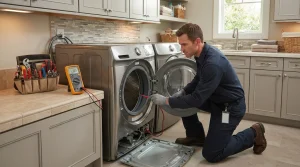
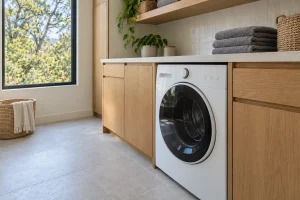
When a washer fails, the whole household feels it within a day. Towels pile up, a drum full of soaked laundry will not drain, or a cycle that used to run quietly now thumps across the floor. We repair LG washers in San Francisco and around the Bay Area, from compact front-loaders in hallway closets to large top-loaders and stacked WashTower units, and we begin with a proper diagnosis rather than a guess.
A washer that stops with a full tub is nearly always telling you about drainage: a clogged drain pump filter, a kinked or crushed drain hose, a standpipe that is too narrow or too full of old lint, or a pump that has stopped turning. Coins, hair ties and small socks are frequent culprits on front-loaders. The drain-related code is explained at OE.
If the drum stays empty or fills very slowly, check the supply taps first. Beyond that, inlet screens can clog with sediment, and the inlet valve itself can wear out. The matching display message is covered under IE.
A front-load door that will not lock, or a top-load lid that does not register as closed, keeps the cycle from starting. Gasket debris, a worn latch or a damaged door switch can be behind it. See dE and dL.
Violent spin cycles often come from an uneven load or a machine that is not level, but worn shock absorbers and suspension parts can also be responsible. The related message appears as UE.
A sour smell in a front-loader usually builds in the gasket fold and the detergent drawer, as covered in front-load washer musty odor. A cycle that seems to run forever may be extending itself to correct an unbalanced load or heavy suds; see washer cycle takes too long.
Water on the floor may come from a loose hose connection at the wall, a split gasket, an overfilled detergent drawer or an internal leak. The internal-leak safety message is AE, and when it appears the machine stops on purpose to protect your floor.
Some LG washers hold detergent in internal reservoirs and dose it automatically. When dosing fails, the pump or the sensing around it may be at fault; washer ezDispense not dispensing explains the owner checks. Wi-Fi and ThinQ app issues, such as the washer showing as offline, are normally router or pairing matters, and you can try re-pairing from the app before calling us.
We listen first. How the washer behaves, at which point in the cycle it stops and what the display says give the technician a map. Then we check the load path from the wall to the drum: supply hoses and screens, drain hose and standpipe, door lock and switch, pump and filter, then the motor, the sensors and the control board. A repair is only proposed once the cause is confirmed, and the proposal arrives as a written estimate. Nothing is replaced until you say yes.
San Francisco laundry spaces vary enormously, and the installation often explains the fault. In a hallway closet or a stacked configuration, there may be little room behind the machine, so hoses get kinked when it is pushed back. Standpipes in older buildings can sit too low or too high, producing siphoning or slow drainage. Washers on upper floors are more sensitive to a floor that flexes, which makes unbalanced-load messages more common. If your washer sits under or beside a dryer, the combined vibration can show up in both.
WashTower stacks combine a washer and dryer in one tower with a shared control. The two halves have separate faults, so we diagnose them separately; the drawer message dE4 is specific to that design. SideKick pedestal washers sit beneath a main front-load washer, and a connection or stacking problem can show as E7. When the small unit will not start, read SideKick washer won’t start for the checks that help.
LG washers display short codes, and they are worth recording exactly. Here are several we see often:
The complete set is in the error code library. Washer-dryer combination units have their own entries, such as dHE for the drying function.
Please do not remove the back or top panel, test the motor, or bridge a door switch.
Turn the washer off at the breaker and close the supply taps if you notice burning smells, sparks, water flowing from the machine or a breaker that keeps tripping. A leak behind the machine can damage a neighbor’s ceiling in a multi-unit building, so do not leave it running unattended.
LG washers share a look but not their parts. Front-loaders, top-loaders, combos and stacked towers differ inside, and the model number is how we pick the right documentation. You will usually find the label on the door frame, inside the lid or along the back edge of the cabinet. Our page on finding your LG model number shows the usual places. Models we see include the front-load WM3090C and the top-load WT7050C.
Send a request through the form with the model number, a description and any code. We agree an arrival window, the technician runs the tests, explains the finding and hands over a written estimate. If you approve, the repair proceeds. Landlords can arrange access for tenants and receive the same written summary. For the whole lineup, see our LG washers overview.
Usually because it cannot drain. A blocked pump filter, kinked hose or failing pump is the typical cause. Start with the filter, then book a diagnosis if water remains.
Often the door stays locked while water remains. Do not force it. Drain the machine through the filter or wait for it to release, and then unlock it.
No. It frequently means a bunched-up load or an unlevel machine. Redistribute the laundry and check the feet before assuming a part has failed.
Yes, and on SideKick pedestal washers and washer-dryer combos. Each part of a stack is diagnosed separately.
No. Diagnosis comes first, then a written estimate, and the work begins only after you agree.
Front-load, top-load, SideKick, combo and WashTower LG washers we repair in San Francisco, with model labels, error codes and safe checks.
Gas, electric and induction LG cooktops checked in San Francisco and the Bay Area: burners, zones and touch controls, with a written…
Water that will not drain, a door that will not latch or dishes that stay dirty? We diagnose LG dishwashers across San…
Long cycles, no heat or a dryer that will not start? We repair electric, gas and ventless LG dryers around San Francisco…
Over-the-range LG microwaves diagnosed in San Francisco and the Bay Area, covering heating, turntable, door, vent fan and keypad faults, with a…
Gas, electric and induction LG ranges and wall ovens diagnosed in San Francisco and across the Bay Area, with a written estimate…
Warm food, frost, leaks or a slow ice maker on an LG refrigerator? We diagnose first, give a written estimate and repair…
LG Styler steam closets diagnosed in San Francisco and the Bay Area: steam, door, airflow and sensor codes, with a written estimate…
Share a few details and we’ll confirm an appointment. Prefer to talk? Call us and we’ll help right away.