Dryers
Electric, gas and ventless heat pump LG dryers we repair in San Francisco, with model labels, airflow tips, codes and safe owner…

Specialized LG Appliance Repair in San Francisco
Mon–Sat: 8:00 AM – 7:00 PM
Electric, gas and heat pump dryers, checked from the vent to the heater.
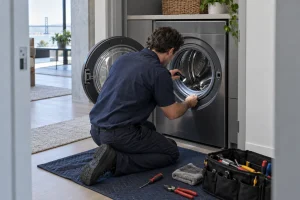
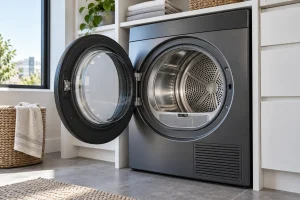
A dryer that takes two cycles to finish a load, shuts off halfway or leaves jeans damp is wasting your evening and, if the vent is part of the problem, creating a hazard. We repair LG dryers in San Francisco and across the Bay Area, covering electric, gas and ventless heat pump designs, plus the dryer half of a WashTower stack.
The most common complaint is clothes still wet at the end of a cycle. Airflow is the first suspect. A lint filter that has gone waxy from fabric softener, a vent run packed with lint or a duct crushed behind the machine can all stretch cycles. LG dryers report restricted airflow through the d75 and related d-series codes.
The drum turns but the air stays cool. On an electric dryer, that can involve a heating element, a thermal fuse or limit device, a sensor, or the home supply itself. On a gas dryer, the igniter, the gas valve coils or the gas supply come into play. Our article on a WashTower dryer not heating covers the stacked version. If the display reads nP, no current is being detected at the heater, which usually relates to home wiring.
A door that is not recognized as closed, a failed belt, a worn motor or a control fault will each leave the drum still. See dE for the door message.
Thermistor problems show up as tE1, tE2 and tE4, and typically need a technician because they point at a sensor or its wiring.
Steam-capable dryers draw water through a small feeder. If the supply is closed or the line is kinked, you may see Add or E05.
Squealing, thumping or scraping usually involves rollers, an idler or a worn drum seal. A burning odor needs immediate attention (see below).
Which type you own changes how we diagnose. An electric dryer relies on a high-draw circuit and a heating element; a failed element, a tripped breaker leg or a loose terminal connection can leave you with a turning drum and cold air. A gas dryer adds an ignition sequence and a gas supply; if your display shows GAS, the dryer is not receiving gas, and on some models a d80 message can also mean low gas supply. Ventless heat pump models recover moisture into water instead of sending it outdoors, so drain hoses, condensate collection and the filter in the sump area matter. The relevant messages are E13 and nd, and our post on heat pump dryer condensate water explains why a ventless dryer can leave water where you did not expect it.
We start by asking what the dryer did before it stopped performing. Then the technician looks at the whole air path, from the lint filter to the outside termination, because many heating complaints are really ventilation complaints. After that comes the electrical or gas side: supply, heater or igniter, sensors and board. The result is a written estimate after the cause is confirmed, and no repair starts without your approval.
Dryers in San Francisco buildings often vent through long, bending runs to reach an exterior wall, and condo associations sometimes limit where a vent may exit. A long or flexible foil duct collects lint quickly, and a vent squeezed between the dryer and the wall behind it can restrict airflow badly. Stacked laundry closets add another complication: the dryer sits at chest height or above, access to the vent is poor, and cleaning it takes real effort. Some apartments do not allow outdoor venting at all, which is where a ventless heat pump model makes sense.
Gas dryers add their own installation concerns: a shutoff valve within reach, a flexible connector that is not kinked and good clearance around the unit. Electric dryers need a cord and receptacle matching the dryer. Our diagnosis notes whether any of these points play a role, and we describe it in the written estimate without making changes you did not ask for.
The error code library lists the rest, and a code is a starting point for the diagnosis, not the diagnosis itself.
Do not open the cabinet, touch gas fittings, test the heater with a meter or bypass any thermal device.
If you smell gas, leave the home immediately, avoid switches and lighters, and call the gas utility or 911 from outside. If you smell something burning or see sparks, switch the dryer off at the breaker and do not use it again until it has been inspected. A dryer that is too hot to touch on the outside, or that keeps tripping its breaker, should also stay off.
LG dryer models differ in fuel, venting and control layout, and the prefix tells part of the story: DLE indicates electric and DLG gas. The label is usually inside the dryer door or along the door frame. With it we can confirm whether you have an electric unit such as the DLE3400, a gas unit like the DLG1502, or a ventless one like the DLHC3602. See finding your LG model number if you cannot locate it.
Submit a request with the model, the symptom and the code. We agree on a time window, the technician tests the dryer and its venting, explains the cause and gives you a written estimate. You approve, or you do not. Landlords and managers can set up access for tenants and receive the same summary. To compare the range of dryers we handle, read our LG dryers guide.
Possible causes include a failed heating element or igniter, a tripped limit device, a sensor fault or, on an electric dryer, half of the supply missing. Diagnosis separates them.
It helps, but the vent duct and the outside termination also collect lint. If cycles remain long after the filter is clean, the vent is the next place to check.
That is what ventless heat pump designs are built for. They still need a drain path or container, and the filters must be kept clean.
You can try one controlled power reset after writing the code down. If it returns, book a diagnosis rather than resetting repeatedly.
No. You receive a written estimate after diagnosis, and only the work you accept is carried out.
Electric, gas and ventless heat pump LG dryers we repair in San Francisco, with model labels, airflow tips, codes and safe owner…
Gas, electric and induction LG cooktops checked in San Francisco and the Bay Area: burners, zones and touch controls, with a written…
Water that will not drain, a door that will not latch or dishes that stay dirty? We diagnose LG dishwashers across San…
Over-the-range LG microwaves diagnosed in San Francisco and the Bay Area, covering heating, turntable, door, vent fan and keypad faults, with a…
Gas, electric and induction LG ranges and wall ovens diagnosed in San Francisco and across the Bay Area, with a written estimate…
Warm food, frost, leaks or a slow ice maker on an LG refrigerator? We diagnose first, give a written estimate and repair…
LG Styler steam closets diagnosed in San Francisco and the Bay Area: steam, door, airflow and sensor codes, with a written estimate…
Front-load, top-load, SideKick and WashTower: we trace drain, door, noise and leak problems on LG washers across San Francisco and the Bay…
Share a few details and we’ll confirm an appointment. Prefer to talk? Call us and we’ll help right away.