

Specialized LG Appliance Repair in San Francisco
Mon–Sat: 8:00 AM – 7:00 PM
Frozen food is hard while the fresh-food side is warm. That split usually means cold air is not being shared properly between the two compartments.
You open the fresh-food compartment and the milk is lukewarm, but the ice cream in the freezer is solid. This pattern is more reassuring than a fully warm refrigerator, because it tells you the compressor and the sealed system are producing cold. The problem is distribution. In most modern refrigerators, including bottom-freezer, French-door and side-by-side designs, almost all the cold is made in the freezer and sent to the fresh-food side through ducts and a damper.
An evaporator behind a panel in the freezer chills the air. A fan pushes that air around the freezer, and some of it is directed through an air channel into the refrigerator section. A damper or air door, controlled by a sensor, decides how much cold to allow. If anything interferes with the evaporator, the fan, the duct or the damper, the freezer can stay cold while the refrigerator warms up.
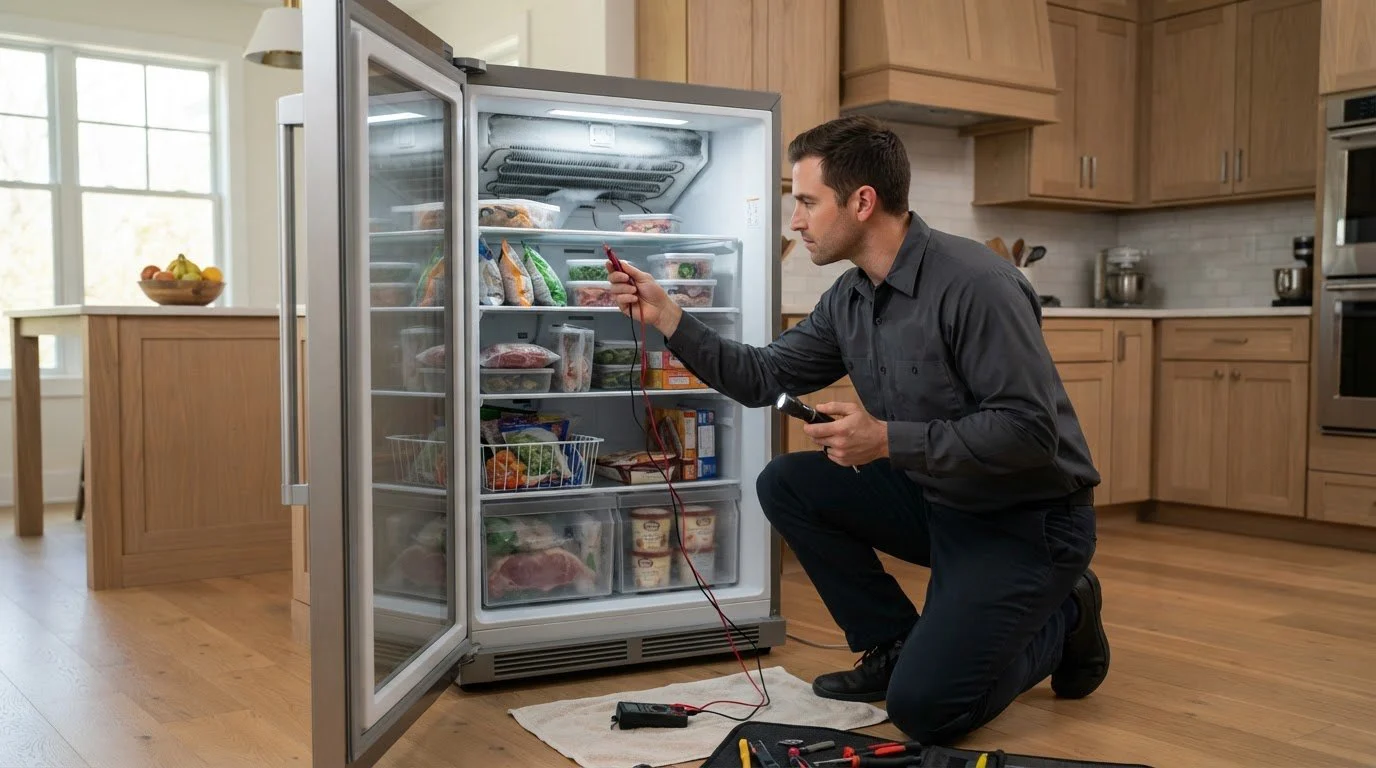
A defrost system melts frost off the evaporator at intervals. If the heater, the defrost sensor or the control fails, frost builds into a solid block, air cannot pass, and the fresh-food side warms. LG codes in this area include dH for defrost heating faults and dS for the defrost sensor. A telltale sign is a freezer that cools but is noisy, with frost visible on the back panel or a pool of ice on the floor of the compartment.
The freezer fan moves the cold air, and frost can lock it up. The FF code is for the freezer fan, while LF and UF cover ice or frost blocking a cooling fan in certain compartments. The refrigerator side has its own fan, flagged by rF. A fan you can no longer hear when the door is open is worth noting.
Groceries stacked against the air vents in the fresh-food section shut off the airflow. Large containers pushed to the back wall, or a flat of drinks held against the vent, are often the entire explanation.
If the door does not close fully, warm air enters and the compartment cannot catch up. The 67 code is about a door not closing fully because of a gap or object. A gasket that is torn, folded or dirty can have the same effect.
The fresh-food side sensors tell the control when to call for cold. Codes rS and r2 cover refrigerator-side sensor faults. A faulty reading can leave the damper closed.
Some owners unplug the unit overnight to melt frost. If you do, empty the freezer first, protect the floor from meltwater, and remember that this treats the symptom for a while and not the cause. Do not chip ice off the back panel and do not touch refrigerant lines.
If the refrigerator side stays warm, move perishables to a cooler or to another working refrigerator, and discard anything that has been warm for an extended period. When in doubt, throw it out.
If vents and doors are fine and the problem returns, a defrost or air-path issue is likely, and a technician should look at it. We diagnose before repair, explain the finding, provide a written estimate and repair nothing without your approval. Get ready with the model number, which is usually on the inside wall of the fresh-food section or on the door frame; this guide shows where to look. See LG refrigerator repair for the visit process, LG refrigerators for the lineup, and examples such as LBNC15251 and LS27H3230.
Notice the details. Are the vegetables in the crisper frozen while the upper shelves are warm? That suggests a damper stuck open in one area. Is the warm side only warm at the back near the vents? Look for blocked airflow. Does frost cover the back wall of the freezer and does the temperature creep up in the evening? Defrost trouble is likely. Does the refrigerator warm after the door has been open for a long period, such as during a party? It may just need time to recover. Keep notes for a day; a simple log of what you saw and when makes the diagnosis faster.
Built-in refrigerators tucked into tight cabinet openings can run warm when the grille and the area above are covered or boxed in. Leave the gaps at the top and sides that your installation manual calls for, and never store boxes on top. In small Bay Area apartments the refrigerator frequently sits beside the oven or in direct sun, and the heat load makes any cooling issue worse.
A warm refrigerator side does not mean you need a new refrigerator. Many causes of this symptom are modest repairs, and a diagnosis separates them from the serious ones. Resist adding ice packs to the back wall or taping over vents; both block airflow further. Avoid cranking every dial to the coldest setting either, since a higher setpoint will not push cold through an iced-over duct. Gather the facts, protect the food, and let a technician test the parts in a sensible order.
Usually not. A working freezer suggests the sealed system is producing cold. The more likely issue is airflow, defrost or a sensor.
Yes. Food blocking the vents prevents cold air from circulating, and an overfull compartment makes it harder to cool.
It can mask a small airflow issue for a while, but if frost has blocked the air path it will not fix the cause.
Ice on the back wall or floor often follows a defrost problem or a door that does not seal. Tell us what you see when you book.
Right away for food safety. Move perishables, then arrange a diagnosis if the fresh-food side does not recover after the simple checks.
Share a few details and we’ll confirm an appointment. Prefer to talk? Call us and we’ll help right away.