

Specialized LG Appliance Repair in San Francisco
Mon–Sat: 8:00 AM – 7:00 PM
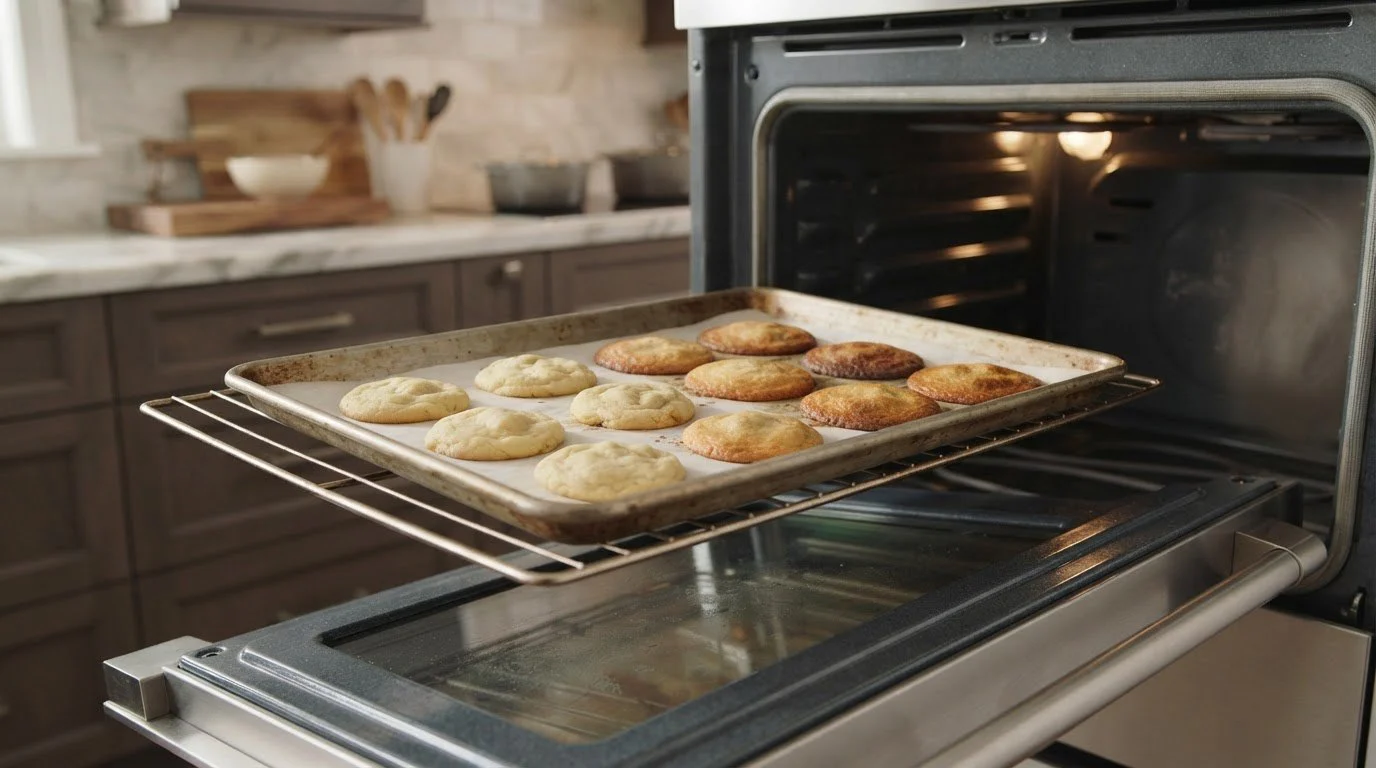
Cookies brown on one side, the cake sinks at the back, a roast is done at the edges and raw in the middle. Learn what uneven oven results point to and what to try.
Every oven has a personality, but a sudden change in how yours bakes is a symptom worth taking seriously. A tray of rolls that used to brown all over now comes out dark on the left and pale on the right. A casserole bubbles at the rim and stays cool at the center. These are the stories that people bring to us from San Francisco kitchens, both in compact apartment ranges and in larger wall ovens.
Uneven cooking is rarely one big failure. It is usually a small imbalance in heat, airflow or sensing that has grown enough to notice. Finding it starts with telling apart what the oven is doing and what you are putting in it.
A surprising number of uneven bakes come from the way the oven is loaded. Large pans pushed to the rear wall block the circulation. Foil on the floor reflects heat to odd places. Two racks full of trays stop air from moving freely. A dark baking sheet browns faster than a light one. Before anything else, remove all extras, place one pan in the center of the middle rack, and bake something simple such as plain toast-style bread slices or a tray of biscuits. If the pattern disappears, your loading was the cause.
Not every uneven result brings up a message, but some do. LG range F17 is a convection fan error, LG range F7 refers to an upper convection fan error, and LG range F16 is an oven sensor issue. Each of those can lead to uneven heating. If you see one, write it down along with the mode in use.
Lay out a single layer of plain bread slices across a light-colored baking sheet and bake them on the middle rack in a standard bake mode. Look at the pattern when they finish. If browning is stronger toward the back or one side, the heat distribution is skewed. If the same pan browns evenly in convection mode but not in standard bake, the fan is probably doing its job and the problem sits with the bake element or the sensor. Take a photo, since the picture helps a technician see what you saw.
Stop there. The inside of the oven, the back panel and the wiring that feeds the elements are not owner territory. A gas smell means leaving the home and calling the gas utility from outside, and sparks or a burning smell mean turning off the breaker.
Even in a perfectly healthy oven, the area near the door loses heat while the back runs warmer. Pans placed side by side behave differently than a single pan in the center, and a very full oven slows the airflow. Understanding these natural gradients keeps you from chasing a fault that does not exist. A fault is more likely when your usual recipes suddenly behave differently, not when a new, crowded pan comes out of the oven uneven.
If the empty oven shows a dark element section, if the fan misbehaves, if the pattern survives your simple test, or if a code returns, book a visit. We diagnose before repairing, send a written estimate and proceed only with your approval. Mention your layout, such as a single wall oven, a stacked pair or a slide-in range. Our LG range and oven repair page explains how a visit works, and the LG Ranges and Ovens guide helps you locate the model label, usually on the door frame. For examples of double ovens, see the LG WDEP9423F repair page.
Yes, to some degree, which is why cooks rotate trays halfway through. The warning sign is a change from how your own oven used to behave.
Convection often helps, but if it is the fan or sensor that is failing, convection can make the pattern worse. Compare both modes to see which one misbehaves.
Heavy spills can block the sensor or burner ports and distort heat. Light wiping is fine, but do not scrub near the sensor or element.
In a double or combination oven each cavity has its own parts, so one can fail while the other behaves. Tell us which cavity and which mode.
You can keep using it for simple tasks if it shows no code, no smell and no sparks. Stop at once if any of those appear.
Share a few details and we’ll confirm an appointment. Prefer to talk? Call us and we’ll help right away.