

Specialized LG Appliance Repair in San Francisco
Mon–Sat: 8:00 AM – 7:00 PM
Fermentation depends on steady cold. If the compartment swings, the first things to examine are the lid seal, placement, sensor readings and the cooling circuit.
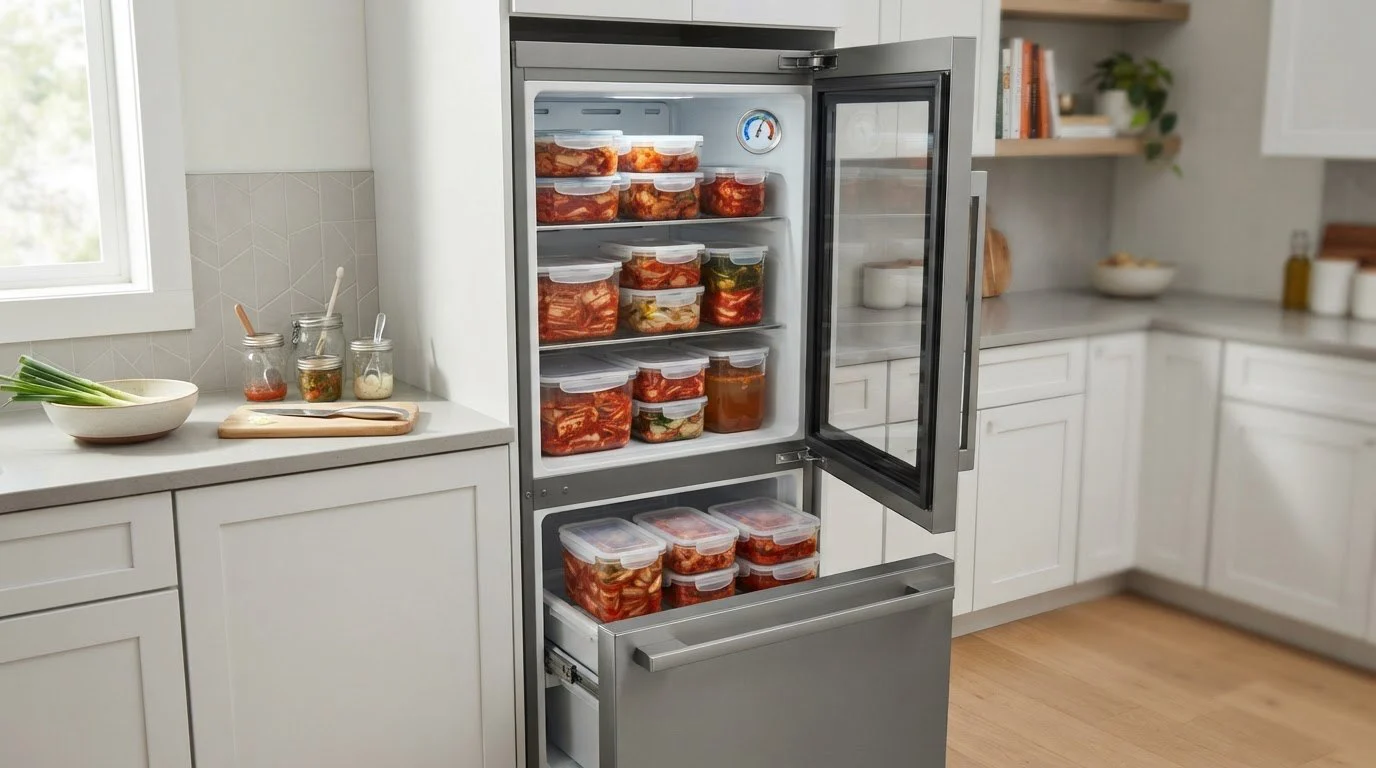
A dedicated kimchi refrigerator is built to hold a steady, gentle cold for long periods, so a compartment that rises and falls is a real problem for what is inside. You may notice a sour smell that arrives faster than usual, a sticky film on the lid, or a display that shows the temperature changing without anyone touching it.
These units keep a small compartment at a set condition, adjusting the cooling in steps so the fermentation does not run away or stall. That needs three things working together: an even seal at the lid or drawer, free airflow around the cabinet so heat can leave, and sensors that report the true compartment temperature to the control board. A weakness in any of them makes the temperature move.
Do not move the temperature setting up and down repeatedly; the control needs time to settle. Do not open back panels, touch the compressor area or add insulation around the cabinet. Never throw away a batch without checking whether it is actually spoiled, but do not eat fermented food that has an unusual smell and a slimy surface.
We note the installation space, the airflow around the cabinet, the seal, the sensor readings against a reference and the cooling operation. A kimchi unit has less volume than a typical refrigerator, so small faults show up fast. After diagnosis you receive a written estimate, and nothing is repaired without your approval.
We also need the model number, because a kimchi unit is a specialized product and parts differ from general refrigerators. The label is usually found inside the cabinet or on a rear panel edge. If you also own a conventional French-door unit such as the LG LB12C2000 refrigerator repair model, listed at 12.1 cu ft, tell us which appliance has the problem.
A kimchi refrigerator runs in programs for different stages of fermentation and storage, so a temperature that changes by design should not be confused with a fault. Selecting a different mode, or a mode that runs a warm stage for a time before returning to cold, will show a different number on the display. Check which mode is active before assuming a problem. If the display shows a steady mode but the compartment feels clearly warmer or colder than the number, the sensor or the cooling is in question.
Seasons matter too. In a warm kitchen the unit runs for longer and the cabinet shell warms. In a very cool garage or a pantry on a cold night the unit may cycle less and leave the compartment warmer than the display suggests. Placing it in a stable room away from large temperature changes is the simplest improvement, and it needs no parts at all. A unit in a garage or a sun-facing porch deserves a second thought, because wide swings in room temperature are harder for the control to follow than a steady warm kitchen.
If giving the unit room and fixing the lid seal does not stabilize the temperature, book with our LG refrigerator repair service. The LG refrigerators guide describes the styles we cover, including kimchi refrigerators.
The cabinet sheds heat to the room. In a tight alcove or beside a heat source it cannot, so the compartment warms.
Keep an eye on smell and texture. If the compartment feels clearly warmer than normal, move containers to a conventional refrigerator.
Yes. A gap lets room air into a small compartment, which changes the temperature quickly.
One controlled power reset is fine. If the swings return, a sensor or cooling fault is likely.
The model label, when the swings began, where the unit sits and any code on the display.
Share a few details and we’ll confirm an appointment. Prefer to talk? Call us and we’ll help right away.